

A Stick of Incense Speaks: The Thousand-Year Soul I Carry
Article Summary
This is the story of incense — told from the perspective of a single stick. It traces the 2,000-year journey of Chinese incense culture, from its sacred origins in ancient rituals to its refinement by Tang and Song scholars, and finally to its place in modern life. A cultural history wrapped in a personal voice.
Introduction
I am a stick of sandalwood incense stick from China‘s Incense Capital. Right now, I lie quietly on your desk, waiting for the moment to be lit.
You may not know this, but inside my slender body hides a story that spans thousands of years. Every wisp of smoke I release does not rise out of nothing — it is the echo of ancient prayers, the sigh of Chinese Tang and Song literati, and the wind that once blew across the Maritime Silk Road.
Let me tell you where I began.
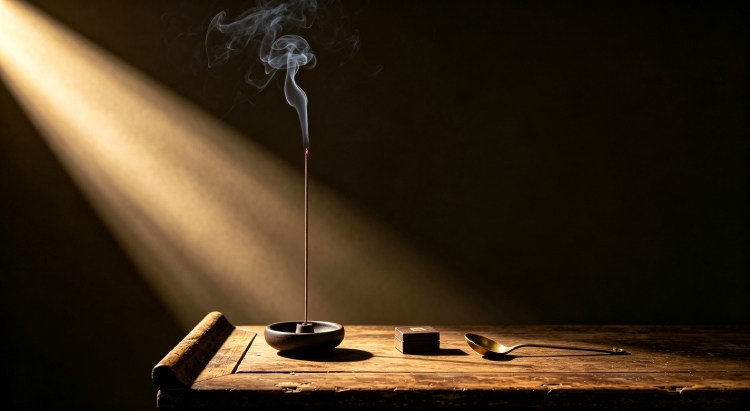
I. My Birth: A Dialogue with the Divine (Neolithic Period – c. 200 BCE)
My ancestors were not agarwood or sandalwood. They were the most humble plants in the fields — a sprig of mugwort, a tuft of fragrant grass.
One dusk in the Neolithic Age, my ancestors were thrown into a fire. The rising smoke, carrying the scent of plants, was seen as a messenger to heaven. People believed: burning was speaking, and the higher the smoke rose, the clearer the gods could hear.
In the Shang and Zhou dynasties (c. 1600–256 BCE), people brewed a ceremonial wine called chàng from tulip-like herbs and black millet, pouring it onto the ground as an offering to heaven and earth. That was my earliest moment of glory: sacred, pure, and untouchable. I was the first love letter humanity ever sent to the sky.
II. My Growth: Exotic Fragrances Along the Silk Road (c. 200 BCE – 600 CE)
About two thousand years ago, during the Han dynasty (202 BCE – 220 CE, roughly contemporary with the Roman Republic), the explorer Zhang Qian opened the Silk Road. A long, winding route brought me to central China from distant lands.
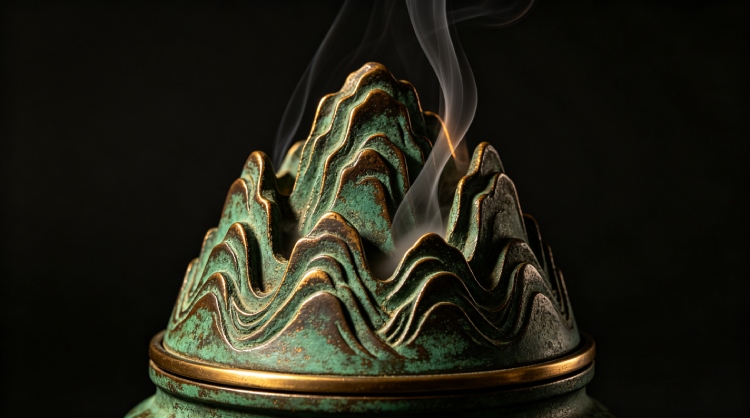
For the first time, I met sandalwood, agarwood, and benzoin — resins solidified into souls, from India, Arabia, and even Africa. Inside the palace walls, nobles and emperors fell in love with me. They cast the magnificent “Boshan” censer — its lid carved into layered mountain peaks. When I burned inside, smoke curled out through the crevices like a fairyland.
From that moment on, I was no longer just an altar messenger. I entered palaces and noble feasts, becoming a symbol of status and elegance. My fragrance began to be savored, not just offered in prayer.
III. My Refinement: Between the Hands of Scholars and Zen Monks (600–1368 CE)
Then came the Tang dynasty (618–907 CE), a golden age of openness. Buddhism and Taoism flourished. As monks sat in meditation, I burned softly beside them. Around that time, people invented “separate-heat incense burning” — placing a piece of mica or silver foil between the charcoal and me, so I could release my purest scent without smoke. It was a restrained, profound kind of beauty.
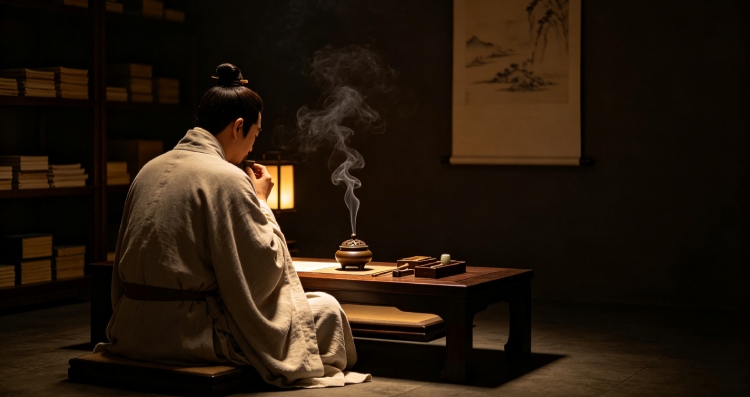
But the age I am most proud of is the Song dynasty (960–1279 CE). That was a time when people truly understood me. The Song literati listed incense appreciation alongside tea tasting, painting, and flower arranging as the “four refined pastimes.” Not idle amusements, but introspective practices — the subtlest way of savoring life.
Scholars and poets wrote verses for me. They gathered not to compete over wine, but over incense. They ranked agarwood, sandalwood, and ambergris, and compiled China’s first incense monograph, the Xiang Pu (Incense Manual). They equipped me with a full set of tools: delicate censers, incense bottles, boxes, scoops, and tongs — every piece with its proper form and usage.
In that era, I was no longer just drifting smoke. I was a poem, a painting, a conversation with one’s inner self. Subtle, restrained, refined — this was the soul the Song gave me. It remains my noblest character to this day.
IV. My Everyday Life: From the Scholar’s Studio to Ordinary Homes (1368–1911 CE)
During the Ming and Qing dynasties (Ming: 1368–1644; Qing: 1644–1911), I gradually moved out of the scholar’s study into a wider world.
The “Three Incense Essentials” — one censer, one bottle, one box — became standard furnishings in every household’s main hall. Incense sticks — the long, slender shape I have today — were invented exactly at that time. I became simple and convenient. No more complicated separate-heat rituals. Just a light, and I burn.
I entered temples, accompanying monks during morning and evening chants. I stayed in women’s chambers, adding a touch of quiet longing. I kept vigil in studies, keeping scholars company as they read late into the night. I also appeared in seasonal rituals, weddings, and funerals … the sacred and the everyday, balanced in me.
Conclusion
I am small and thin, and my burn time is only 45 minutes. But behind my mellow, lingering fragrance lies an entire history of Chinese incense culture. It is not just about scent — it is about ritual, art, philosophy, and the essence of Eastern aesthetics.
Sometimes I hear people ask: “Is burning incense good or bad?”
The answer speaks for itself. Throughout the long flow of history, only good things have been passed down.
There is just one thing you need to pay attention to: choose incense made from natural materials.
FAQ
Q1: What is the purpose of Chinese incense sticks?
Chinese incense sticks are used for meditation, ancestor worship, space cleansing, and daily ambiance. They carry cultural and spiritual significance rooted in thousands of years of tradition.
Q2: Why do Chinese burn three incense sticks?
In Buddhism, three sticks represent the Buddha, the Dharma, and the Sangha. In Taoism and folk tradition, they symbolize Heaven, Earth, and Humanity. For home use, a single stick is perfectly fine.
Q3: Does incense expire?
Natural incense does not spoil like food, but its aroma can fade over time. Stored properly in an airtight container in a cool, dry place, premium incense can last for years — and some, like agarwood, even improve with age.
Related Products
Premium Incense Sticks – Sandalwood, agarwood, and herbal blends. 100% natural, available for wholesale and private label.

Ceramic Incense Holders – Elegant and heat-proof, perfect for sticks and cones.

About Kuanggu Incense
Kuanggu Incense was founded in 2021 in Quanzhou, Fujian — the starting point of the Maritime Silk Road. We are rooted in China's Incense Capital, where over 1,000 years of incense-making heritage, 300+ enterprises, and US$2.1 billion in annual output value make us a trusted source for premium natural incense.
We offer incense sticks, cones, coils, innovative incense products , and other accessories — fully customizable — with private label, OEM, ODM and flexible MOQ for brands worldwide.
More than a supplier, we are inheritors of Chinese incense culture, blending ancient wisdom with modern quality to bring Eastern fragrance to the global market.
Ready to bring quality incense to your product line? [Contact us]
Kuanggu Incense — Rooted in China‘s Incense Capital, sharing the fragrance of the East with the world.
- Incense Pellets: The Eastern “Scented Candle” You’ve Never Heard Of
- How to Customize Incense: A Complete Guide for Brands & Retailers
- Incense vs. Candles: Which Is Better for Your Space?
- Why Does Custom Sampling Cost So Much? – A True Story
- Incense in Religious & Spiritual Traditions: What Do Scriptures Say?
- Incense & Your Health: What Science Says About Brain, Lungs & Sleep
