

How to Burn Incense Correctly: 7 Common Mistakes and Best Practices
Article Summary
This article covers the essentials of burning incense correctly — from proper lighting techniques to common mistakes that can ruin your experience or create safety risks. We also provide a quick guide to choosing quality incense and simple safety tips to keep in mind. Whether you‘re new to incense or a regular user, this guide helps you burn safely and enjoyably.
Introduction
People have been burning incense for thousands of years—and for good reason. That thin curl of smoke, the gradual release of fragrance, the quiet ritual of lighting a stick—a simple act that can shift the energy of an entire space.
But here's the thing: done wrong, good incense goes to waste. Done carelessly, it becomes a fire hazard.
Whether you're a spa owner adding ambiance to treatment rooms, a retailer curating a mindful shopping experience, or someone who simply enjoys a stick of sandalwood after a long day—getting it right makes all the difference.
Let's walk through the most common mistakes—and how to avoid them.
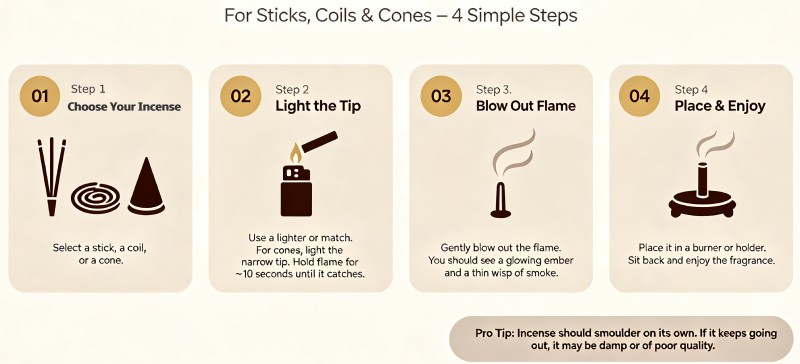
How to Light Incense Properly
Before we talk about mistakes, let's get the basics right.
7 Common Mistakes to Avoid
Mistake #1: Burning in an enclosed space
This is the most common mistake. In a sealed room, smoke and particulate matter build up, irritating the airways.
The fix: Always burn incense in a well-ventilated area. Open a window or door to allow fresh air to circulate.
Mistake #2: Burning near flammable objects
This one is often overlooked. Curtains, paper, lampshades, clothing—a single ember can spark a fire.
The fix: Always burn incense in a proper incense holder/burner. Keep it at least 20 inches (50 cm) away from anything flammable.
Mistake #3: Burning in a draft
An open window is good—but a drafty window is not. A gust of wind can scatter ash, knock over your holder, or cause uneven burning.
The fix: Keep your burner/holder away from open windows, fans, or air vents.
Mistake #4: Leaving burning incense unattended
This should go without saying, but it's worth repeating: never leave burning incense unattended.
The fix: If you leave the room, go to bed, or step out—make sure the incense has finished burning, or extinguish it first.
Mistake #5: Using the wrong holder/burner
A holder/burner that's too shallow, too light, or made of flammable material is an accident waiting to happen.
The fix: Use a stable, tip-proof, heat-resistant holder/ burner. No holder/ burner on hand? Use a non-flammable bowl, dish, sand, or metal clips to create a temporary one.
Mistake #6: Letting ash pile up
Ash that falls outside the holder can stain furniture—and if still hot, it's a fire risk.
The fix: Choose a properly sized holder. If your holder is too small, place it on a dish or tray to catch falling ash. Clean it regularly.
Mistake #7: Burning poor-quality incense
This doesn't just affect the experience—it affects your health.
The fix: Always choose incense made from natural ingredients—pure raw materials, no chemicals. Safe for everyone in the home, including children and the elderly.
Best Time of Day to Burn Incense
The "best" time depends on what you want to achieve.
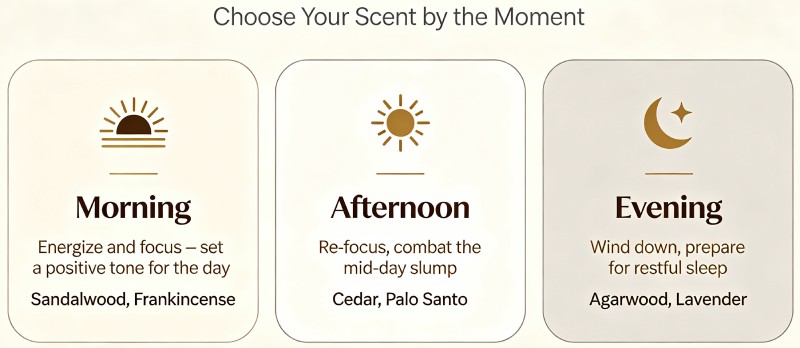
A incense cone burns for 10–20 minutes, a incense stick for approximately 45 minutes, and a incense coil for 2–4 hours. Choose the format based on your specific needs.
Does Incense Really Work?
Yes—but "work" depends on what you expect it to do.
If you expect it to magically solve your problems? No. If you expect it to shift the atmosphere, calm your mind, and make a space feel intentional? Absolutely.
Research supports this: studies have shown that agarwood and cinnamon—common incense ingredients—have stress-reducing and relaxation-promoting properties. In one clinical study, 85% of participants reported positive benefits from using incense, with all who tried calming scents giving a 100% positive rating.
Incense works because ritual works. The act of lighting a stick, watching the smoke rise, and breathing in a natural fragrance signals to your brain: "Slow down. This moment matters."
At the end of the day, effectiveness comes down to three things: the quality of the incense, proper burning technique, and your intention.
Conclusion
Burning incense is both an art and a practice. When done correctly, it enhances your environment, supports mindfulness, and brings a sense of peace to any space. When done carelessly, it can be wasteful or even dangerous.
The good news? Most mistakes are easy to avoid. Choose quality natural incense, use a proper holder, ensure good ventilation, and never leave it unattended. With these simple habits, you can enjoy the full benefits of incense — safely and beautifully, every time.
FAQ
Q1: How long are you supposed to burn incense?
For sticks, about 45 minutes. For coils, 2–4 hours. For cones, 10–20 minutes. Always let it burn completely in a safe holder.
Q2: Is it safe to burn incense in your house?
Yes, when done correctly. Choose natural incense, ensure proper ventilation, use a stable holder, and never leave it unattended.
Q3: What are the common mistakes when burning incense?
Burning in enclosed spaces, near flammable objects, or in drafts; leaving it unattended; using the wrong holder; letting ash pile up; and burning poor-quality incense.
Related Products
Natural Incense Coils – Kynam Agarwood. 100% natural, Handcrafted, available for wholesale and private label.

Incense Burners – Round Alloy Censer with Deer Finial, for coils and cones. Heat-proof and stable.

About Kuanggu Incense
Kuanggu Incense was founded in 2021 in Quanzhou, Fujian — the starting point of the Maritime Silk Road. We are rooted in China's Incense Capital, where over 1,000 years of incense-making heritage, 300+ enterprises, and US$2.1 billion in annual output value make us a trusted source for premium natural incense.
We offer incense sticks, cones, coils, innovative incense products , and other accessories — fully customizable — with private label, OEM, ODM and flexible MOQ for brands worldwide.
More than a supplier, we are inheritors of Chinese incense culture, blending ancient wisdom with modern quality to bring Eastern fragrance to the global market.
Ready to bring quality incense to your product line? [Contact us ]
Kuanggu Incense — Rooted in China's Incense Capital, sharing the fragrance of the East with the world.
- Incense Pellets: The Eastern “Scented Candle” You’ve Never Heard Of
- How to Customize Incense: A Complete Guide for Brands & Retailers
- Incense vs. Candles: Which Is Better for Your Space?
- Why Does Custom Sampling Cost So Much? – A True Story
- Incense in Religious & Spiritual Traditions: What Do Scriptures Say?
- Incense & Your Health: What Science Says About Brain, Lungs & Sleep
