

How to Choose the Best Incense for Your Brand: A B2B Buyer’s Guide
Article Summary
This guide is written for B2B buyers sourcing incense for their brand, retail shop, meditation & yoga studios,etc. We cover the different incense formats (incense sticks, incense cones, incense coils) and compare the five main scent categories — natural woody, floral, herbal, traditional Chinese Blends, and modern Japanese-style perfume incense. You’ll learn how scent projection, aging characteristics, and stick thickness impact your purchasing decisions, and how to match the right product to your target market‘s expectations.
Introduction
As a B2B buyer, choosing incense is not about personal preference. It’s about matching a product to a customer profile, a brand positioning, and a price point. A luxury hotel in Dubai has different expectations than a mindfulness studio in Portland. A mass-market retailer needs a different product than a niche cultural brand.
At Kuanggu Incense, our product line spans from 100% natural traditional Chinese blends to modern Japanese-style perfume incense. These are fundamentally different products with different aging profiles, scent behaviors, and target audiences. This guide will help you navigate that landscape objectively.
Understanding Incense Formats
Before diving into scent categories, it’s essential to understand how the physical form of the incense impacts its performance.
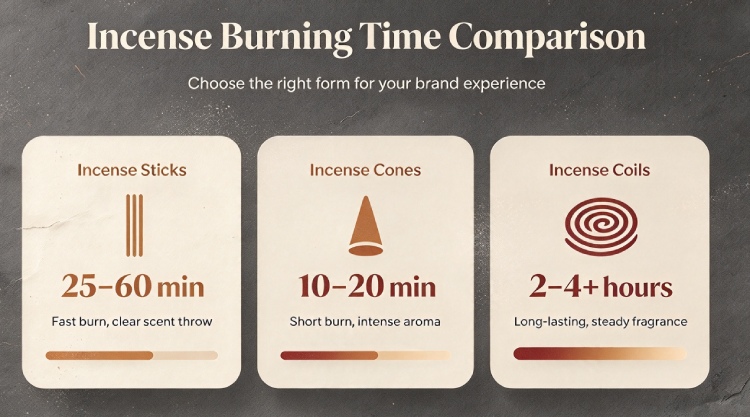
Incense Sticks are the most common and versatile. They offer a steady, consistent fragrance over a longer period. Perfect for daily use.
Incense Cones burn hotter and faster, releasing a stronger scent in a shorter time. Ideal for quick room refreshes or short rituals.
Incense Coils are designed for long, continuous burn. Great for temples, large spaces, or all-day fragrance.
Choose the format based on how long you want the fragrance to last and how intense you want it to be. Once you have the format in mind, the next decision is the scent category.
The Five Categories: A Buyer‘s Framework
We categorize our incense into five directions. The first four are crafted entirely from natural plant materials. The fifth uses essential oils and high-grade fragrance compounds for a distinctly different sensory experience.
1. Natural Woody Scents (Sandalwood, Agarwood, Palo Santo,etc.)
2. Natural Floral Scents (Rose, Jasmine, Osmanthus, etc.)
3. Natural Herbal Scents (Sage, Cedar, Mugwort,etc.)
4. Traditional Chinese Blends (Complex historical formulations)
5. Modern Japanese-Style Perfume Incense (Fragrance-forward, bold, immediate)
The first four share a common DNA: they rely on the volatile aromatic compounds naturally present in wood, flower, and herb. The fifth is engineered for a different purpose — to deliver a strong, unified, and immediately recognizable scent profile.
Scent Projection: Restrained vs. Bold
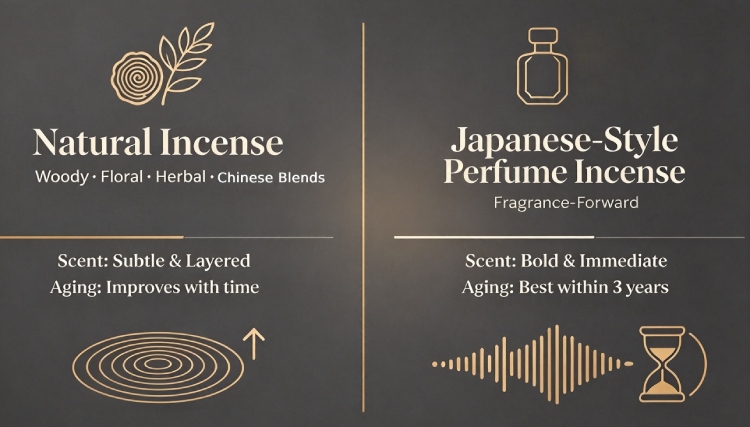
This is the single most important distinction for B2B buyers to understand, because it directly affects customer satisfaction and return rates.
The Natural Categories: Subtle, Layered, Introspective
Natural woody, floral, herbal, and Chinese Blends incense burns with a restrained, elegant projection. The aroma unfolds slowly as the stick burns, revealing layers that require a quiet environment to appreciate. This is not a defect — it is the nature of pure plant material. The experience is closer to tasting a fine tea than drinking a flavored beverage.
For a B2B buyer, this means: if your customers expect an immediate, room-filling scent, natural incense alone may disappoint them. This is a critical expectation to manage.
Japanese-Style Perfume Incense: Bold, Immediate, Unapologetic
Japanese-style perfume incense is formulated with natural wood powders, essential oils, and high-grade fragrance compounds. The result is a strong, outgoing, and fast-diffusing aroma that fills a room within minutes. It is designed for customers who want an instant sensory impact — a modern hotel lobby, a retail space that needs a signature scent, or a consumer who expects to smell something the moment they light it.
The trade-off: Perfume-style incense does not develop or deepen with age. The fragrance compounds evaporate over time. For optimal performance, it should be used within approximately 3 years of production.
Aging Characteristics: A Critical Buying Decision
This is where the distinction between natural and perfume-style incense becomes commercially significant for your inventory management.
Natural Incense: “Ages Like Fine Wine”
Natural incense — particularly woody and resinous varieties — undergoes a slow chemical transformation when stored properly. The harsh edges of fresh plant material soften, and the aroma becomes rounder, deeper, and more complex over time. This is why premium agarwood and sandalwood are often deliberately aged by incense houses before sale.
For B2B buyers: This means natural incense has a long shelf life if stored correctly (sealed, away from moisture, heat, and light). It is not a perishable product in the conventional sense. You can hold inventory without fear of rapid degradation. In fact, some customers may prefer aged natural incense for its mellowness.
Perfume-Style Incense: “Best Within 3 Years”
Because it contains essential oils and fragrance compounds, perfume-style incense does not improve with age. The aromatic molecules gradually evaporate, and the scent weakens. It is at its best in the first 2–3 years.
For B2B buyers: Perfume-style incense should be ordered in quantities that align with your sell-through rate. Over-ordering can lead to unsold stock losing its potency. This is a different inventory discipline than natural incense.
The Special Case: Traditional Chinese Blends
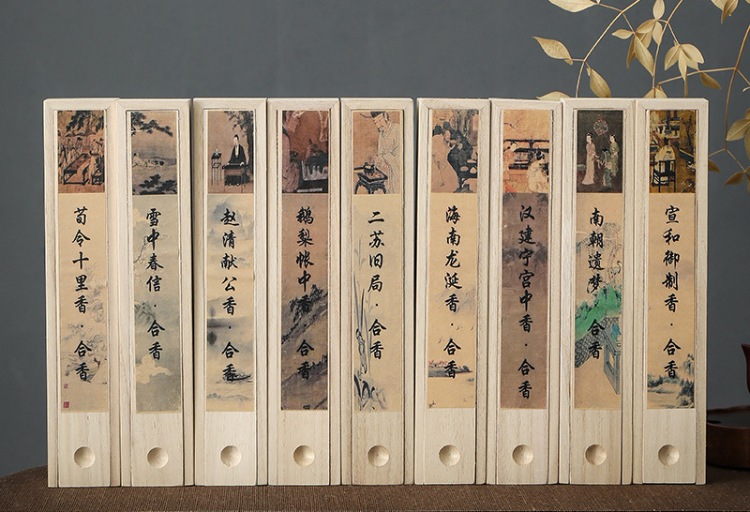
Chinese Blends is the most culturally distinctive category we offer. It is based on the traditional Chinese medical philosophy of “Xiang Yao Tong Yuan” (Incense and Medicine share the same origin). Most blends ingredients are also medicinal herbs — agarwood, sandalwood, clove, cinnamon, and dozens of others.
The wellness proposition: Beyond olfactory pleasure, Chinese Blends is traditionally associated with calming the mind, purifying the air, and supporting relaxation. This is not a marketing claim — it is the historical foundation of the category.
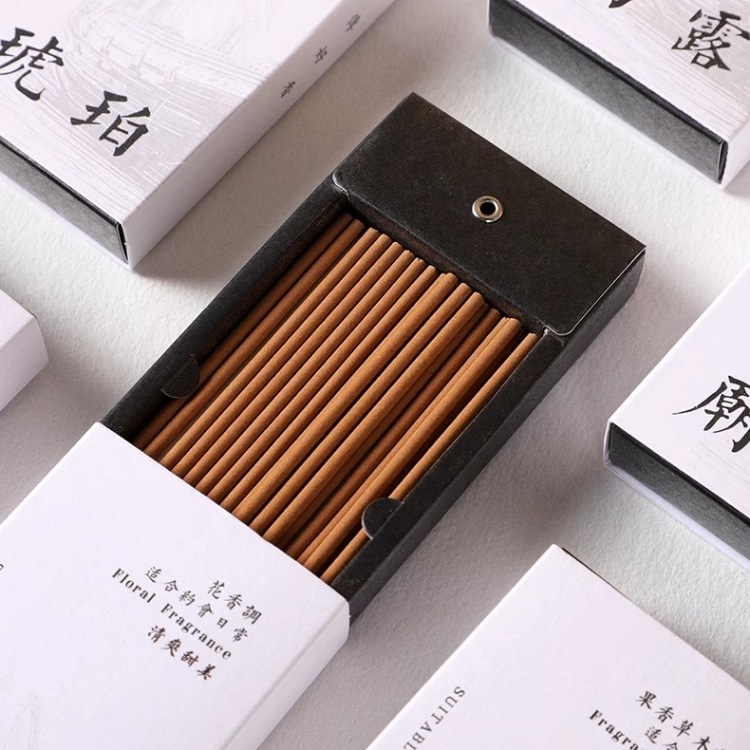
Addressing the “medicine smell” misconception: Many international buyers assume all Chinese Blends smells like strong herbal medicine. This is false. While some formulas (like Imperial Court of Han) have a pronounced herbal character, many others (like Pear in the Bedchamber or Spring in the Snow) are floral, sweet, and fruity. The complexity is the point — Chinese Blends is a symphony, not a single note.
The “Scentless” Problem: Why Natural Incense Can Seem Weak
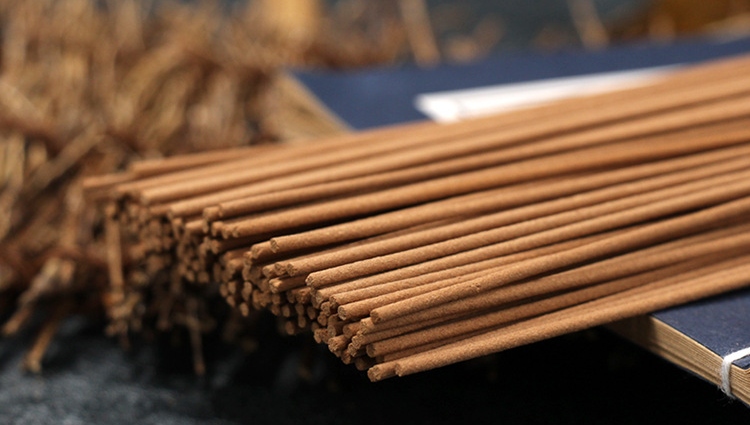
A common piece of feedback from B2B clients: “I tried the natural samples, but I couldn‘t smell anything.”
This is not a quality issue. It is a calibration issue. If you or your customers are accustomed to Japanese-style perfume incense or mass-market synthetic incense, your nose is calibrated to a much higher intensity threshold. Natural incense sits far below that threshold.
Two solutions:
1.Time and attention: Natural incense reveals itself over the burn, not in the first 30 seconds.
2. Stick thickness: This is the technical lever. Thicker sticks (e.g., 3.0mm) deliver significantly more aroma per burn than thin sticks (e.g., 1.8mm). The reason is structural: coarse incense requires less fine grinding and less binder, preserving more aromatic plant material per gram. If your market demands a stronger natural scent, we can produce thicker sticks without adding synthetic fragrance.
How to Choose for Your Market
| Your Customer Profile | Recommended Category |
| Modern hotels, retail spaces, consumers expecting immediate impact | Japanese-Style Perfume Incense |
| Wellness studios, mindfulness brands, cultural retailers | Natural Woody, Floral, Herbal |
| Luxury brands seeking storytelling, differentiation, and aging potential | Traditional Chinese Blends |
Markets new to natural incense, needing a “bridge” product ,Perfume-Style as entry, transitioning to Natural.
A practical B2B strategy: use perfume-style incense to acquire customers and generate revenue, while introducing natural incense as a premium, long-term product line. The two are not competitors. They serve different moments and different customers.
FAQ
Q1: Do Japanese-style incense sticks expire?
Yes. Because they contain essential oils and fragrance compounds, they are best used within 3 years to guarantee optimal scent strength.
Q2: Does Chinese Blends always smell like medicine?
No. While some traditional blends have herbal notes, many are floral and sweet. The “medicinal” perception comes from a few specific formulas, not the entire category.
Q3: Why do natural incense sticks smell so mild?
If you are accustomed to perfume or synthetic incense, natural incense will seem subtle by comparison. You can choose thicker sticks (e.g., 3.0mm) to increase scent intensity without adding synthetic fragrance.
Q4: Can natural incense be stored for years?
Yes. Natural woody and resinous incense, when sealed and kept away from moisture and heat, can be stored for years. The aroma becomes smoother and more mellow over time.
Q5: Can I mix perfume-style and natural incense in one order?
Absolutely. Many of our B2B partners carry both lines to serve different customer segments. We support mixed orders and OEM/private label for both categories.
Related Products
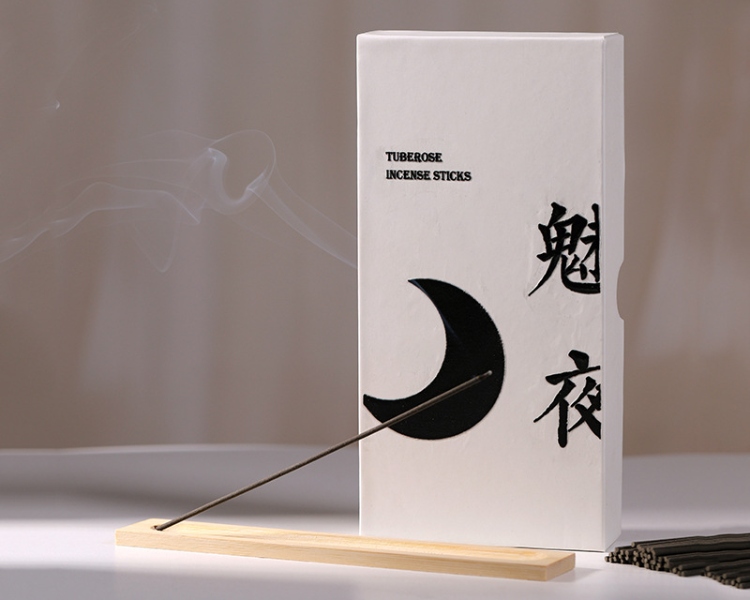
Japanese-Style Perfume Incense Sticks – Bold, room-filling, and ready for immediate impact.
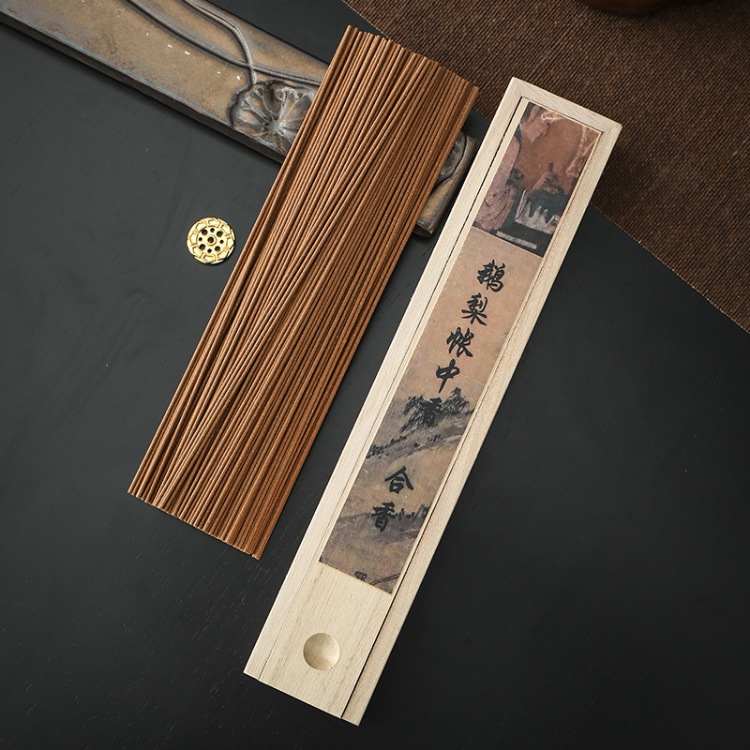
9 Ancient Chinese Blends Formulas – 100% natural, available in premium wooden boxes.
About Kuanggu Incense
Kuanggu Incense was founded in 2021 in Quanzhou, Fujian — the starting point of the Maritime Silk Road. We are rooted in China's Incense Capital, where over 1,000 years of incense-making heritage, 300+ enterprises, and US$2.1 billion in annual output value make us a trusted source for premium natural incense.
We offer incense sticks, cones, coils, innovative incense products , and other accessories — fully customizable — with private label, OEM, ODM and flexible MOQ for brands worldwide.
More than a supplier, we are inheritors of Chinese incense culture, blending ancient wisdom with modern quality to bring Eastern fragrance to the global market.
Ready to bring quality incense to your product line? [Contact us ]
Kuanggu Incense — Rooted in China‘s Incense Capital, sharing the fragrance of the East with the world.
- How to Choose the Best Incense for Your Brand: A B2B Buyer’s Guide
- Incense Pellets: The Eastern “Scented Candle” You’ve Never Heard Of
- How to Customize Incense: A Complete Guide for Brands & Retailers
- Incense vs. Candles: Which Is Better for Your Space?
- Why Does Custom Sampling Cost So Much? – A True Story
- Incense in Religious & Spiritual Traditions: What Do Scriptures Say?
